Forever's new renderer, and what you cannot turn off
Updated 2026-09-15 · checked against Beta
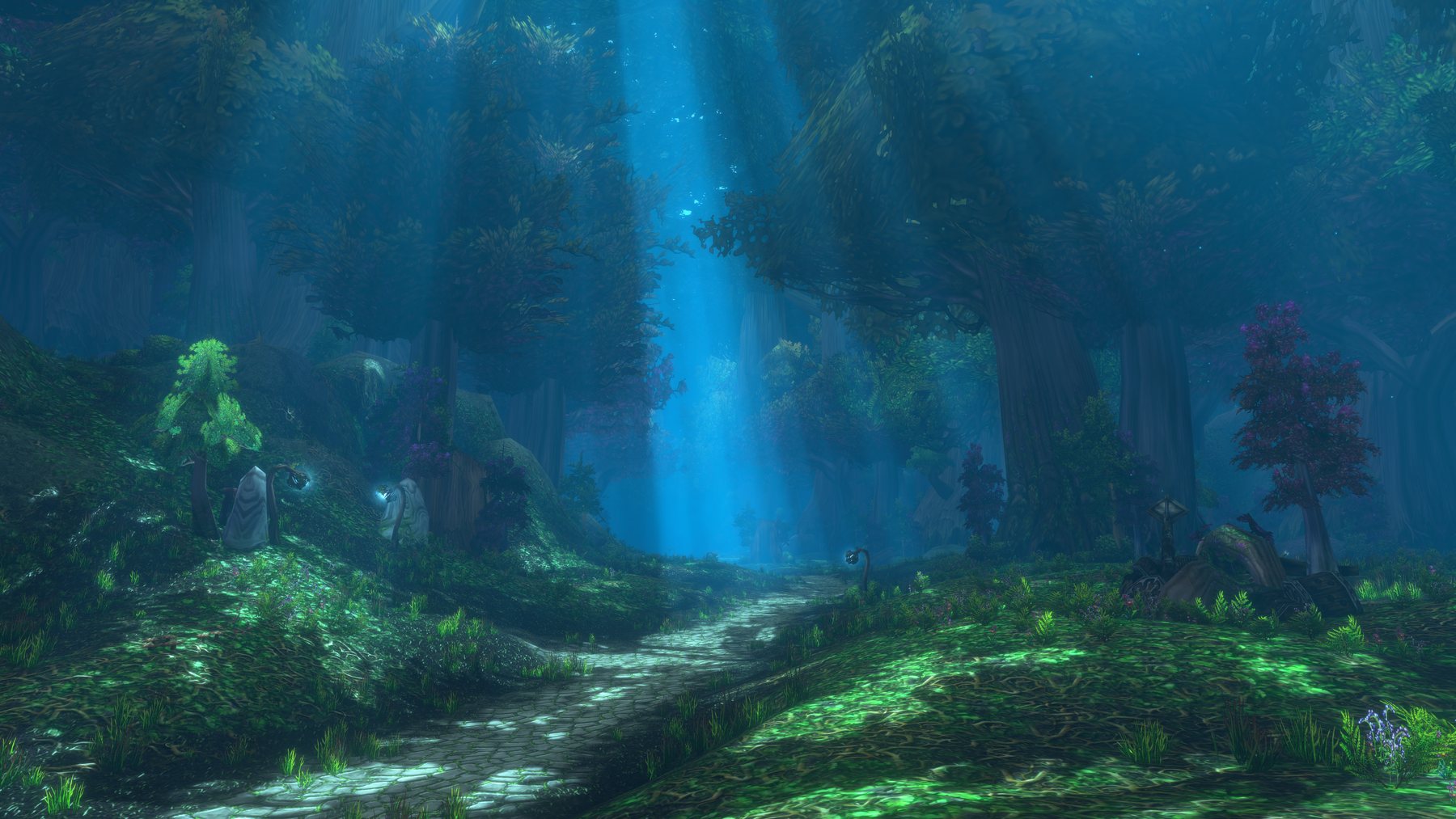
The line being repeated everywhere is that Forever ships an SD/HD toggle, so if you want it to look like 2005 you can have that. Read what the toggle actually covers.
Your character, the NPCs, other player characters, together, unified in either HD or SD.
— Clay Stone, Associate Production Director
That is models and animations. Nothing published says you can switch off global illumination, volumetric fog, dynamic shadows or the new water. The renderer is not a setting; it is the game now. If you have been telling yourself you will just play it in Classic mode, the character in front of you will be the old one and the world behind them will not be.
There will obviously still be a quality slider — a raytracer that runs on a 2016 GPU has to scale. Scaling down is not the same as reverting, and no source has shown the old baked look running in Forever.
What was actually replaced
The engineering panel — Matt Heyman, Lead Environment Artist, and Jason Scott, Lead Software Engineer — split the work into three groups. It is worth keeping them separate, because two of the three are being reported as one thing and the third is barely being reported at all.
Lighting and shadows
Vanilla’s lighting was baked — painted into the world and unable to respond to anything. Forever replaces it with global illumination driven by a raytracer Blizzard wrote themselves. Mountains and models cast shadows according to where the sun is, and those shadows move as it moves. God rays come through the fog.
Fog and draw distance
Volumetric fog, with wind moving through it. In vanilla, fog was there to hide the fact that nothing was drawn past a certain distance; here the distance is extended far enough that the panel demonstrated seeing from the Wetlands to Dun Morogh, and Alterac’s towers from outside the zone. Fog stops being a curtain and becomes weather.
Water — the third of the panel nobody covered
An entirely new water shader, and it got equal billing with the other two.
- Dynamic waves and flow. Rivers flow around obstacles and generate foam.
- Separate authored controls for density, how deep light penetrates, and transparency — per body of water, not one global setting.
- Reflections of the world, the sun and the moon.
Rivers that route around rocks means flow authored across terrain that has never
had it, and three independent water parameters means someone tuned every lake
and coastline individually. The press kit treats it as its own subject —
NewWater is a separate asset category. Every graphics write-up published so far
summarises the panel as “lighting and fog.”
The interesting engineering claim
Jason Scott said the raytracer also runs on the minimum configuration from the published system requirements.
Minimum spec is GeForce GTX 10-series and RDNA 1. Neither has raytracing hardware. Blizzard never said DXR, and never said hardware acceleration — they said they combined existing techniques with new code. On those cards that almost certainly means a compute-shader raytracer running at low internal resolution, which is how you would do this and is a genuinely unusual choice for a twenty- year-old game’s remaster pass.
Recommended spec is RTX 40, RX 7000 or Intel Arc B-series. No frame rate was given for any card at any setting.
Where it has actually been shown
Nine locations, across three separate sources, and nobody has put them in one list:
| Source | Locations shown |
|---|---|
| The panel | Darkshire, Raven Hill Cemetery, Durotar, Mulgore |
| Side-by-side comparisons | Ashenvale, Theramore |
Press kit NewLighting assets |
Ashenvale, Darkshore, Darnassus, Orgrimmar, Tirisfal Glades |
Note what that list is and is not. It is the zones Blizzard chose to show, not a published list of zones that got a lighting pass. But the choice is informative on its own: it is overwhelmingly Kalimdor forest, the two night-elf and orc capitals, and the plague-lit undead starting zone — which is exactly where the old renderer’s flat ambient light looked worst.
The constraint they set themselves
Everything must be authentic. Everything they create, change or add must be authentic to the world, art style and the memories players have.
And, on restoring the original animations onto the HD models: “No bouncy dwarves in this game.”
The target is the memory, not the screenshot. That is a harder brief than fidelity and a more interesting one, because what people remember Azeroth looking like in 2005 was never what it looked like — it is what a CRT, a 1024×768 window and being nineteen made of it. Building a raytracer to reach that is a strange and specific goal.
What nobody knows yet
- Whether the world rendering can be reverted at all. One aggregator lists a “Classic visual preset” as a separate item from the HD/SD model toggle. No other source mentions it and Blizzard have not described one. This is the single most-wanted answer on this page and it is currently unsourced.
- What SD models under the new lighting look like. That is the combination a lot of people will actually pick, and not one published image shows it.
- Any performance figure. None, for any hardware, at any setting.
- Whether the raytracer uses RT hardware where it exists, or the same compute path everywhere.
- Which existing zones got an authored lighting pass versus which simply inherit the new renderer. Very different amounts of work, and the difference is what decides whether your levelling route looks reworked or just relit.
- Whether any of this is in the 17 September beta build, and at what quality. Beta caps at level 30, so the zones you can reach are the low ones — Durotar, Tirisfal, Darkshore, Wetlands. Two of those are on Blizzard’s showcase list, which is convenient for checking it.